
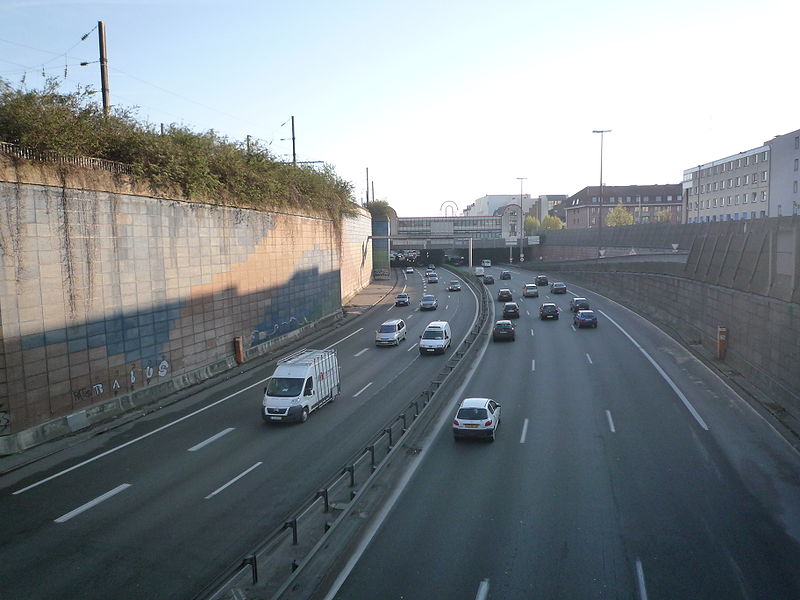
Driving through Paris is not a good idea because of the very impenetrable traffic during mornings and afternoons. Traffic is really heavy mostly during rush hours. You will also find a hard time parking your car especially in the areas surrounding points of touristic attention. Majority of Parisians do not own cars and the roads were designed long before cars were invented. The design of the city’s street system makes people confused and even worsens the situation. If you persevere to drive around the city, be sure you brought a guide along.
It is not recommended to drive in the Paris Metro Area. It is rather convenient driving to a suburban train station and park your car then use the train to go on with your trip all over Paris. Driving may be advisable during evenings but parking difficulties never change. Driving may be a fine alternative when visiting some sights in the suburbs such as Vaux-le-Vicomte and Fontainebleau castle.
Paris has numerous beltway systems. The boulevards were named after Napoleon’s era and jointly referred to as boulevard des maréchaux. These boulevards are standard wide avenues with traffic lights and road signs. There is also freeway-style beltways located outside the boulevard; it is referred to as the boulevard périphérique. The inner lane, which is in clockwise direction, is called périphérique intérieur. The outer lane, which is on a counter-clockwise direction, is called périphérique extérieur. Remember that the périphérique is not an auto route, there is an 80 speed limit and sometimes incoming traffic has the right of way.
There are quite a few auto routes that links Paris with the rest of France. These are A1 and A3 to the north, A5 and A6 to the south, A4 to the east and A13 and A10 to the west. As usual, traffic jams are radically worse during French school break. As mentioned earlier, the multi-lane highway (Périphérique) around Paris is the most preferred route to drive through the centre. Another beltway called L’A86, still in the process of completion, circles around Paris at about 10 kilometers further out from the Périphérique. Another incomplete beltway, called N104 (La Francilienne), is much further out.
Great information! I’ve been looking for something like this for a while now. Thanks!
I could not agree with you more! Traffic in Paris is one of the worst in the world. Especially during rush hour, so if you want to get around through Paris, you definitely have to get moving while it’s still not rush hour!
I love the honesty of this post! I actually chuckled a bit while I was reading through this. Traffic is really bad in Paris, but what I love about the networks of roads of Paris is that it gives you easy access to international destinations. I mean you can practically get from one country to another in a matter of hours. So aside from the traffic, there is still something to be proud about the road connections of Paris.
Getting to Paris by Car somehow has its own advantages and disadvantages. In your part, it would be a convenience for you to travel at your own time and own decision. You can stop over to rest or just drop by some stores at your own will. But there are also consequences, you will be able to experience the heavy traffic of the city. Yes, especially during rush hours, when not only cars but also people, makes the road so busy. But look at the bright side, when you will be able to arrive in Paris, you could use the same car to get around the city at your schedule. It would be a major plus for you to go from one destination to another in this manner.
Thanks for the info. I guess travelling without a car is better not just because you can do away with traffic but also you can enjoy your trip around Paris. You get to meet people, enjoy the views which you might not be able to see when you are inside the car and you can freely go around. For as long as have your map with you plus the guts to ask around in case you get lost, I think travelling around would still be fun without a car. Also, I guess traffic might just ruin your day so its best to go around Paris without a car.
For those who have been regularly going to and from Paris, the traffic could easily get into your nerves. However, first timers especially the tourists would find it a worthwhile experience to be stacked in the traffic and maze of Paris streets. If you’re on business, I better heed the guide that this blog post is giving. Thanks.